In most cases, yes. Flying with a pet on a private jet is usually far simpler than on a commercial airline, because dogs and cats can typically travel in the cabin with their owners instead of in the cargo hold. Whether your own pet can come along, though, depends on the operator, the aircraft and the countries involved.
Chartering privately does not switch off the rules. Operators set their own pet policies, and the destination country decides what an animal needs in order to enter. Pet entry requirements are detailed, differ widely between countries and change from time to time.
This guide explains how pets are usually handled on private flights, what operators may ask for, how entry rules differ in general terms, which costs to expect and what to prepare before departure.
Can pets travel in the cabin rather than the cargo hold?
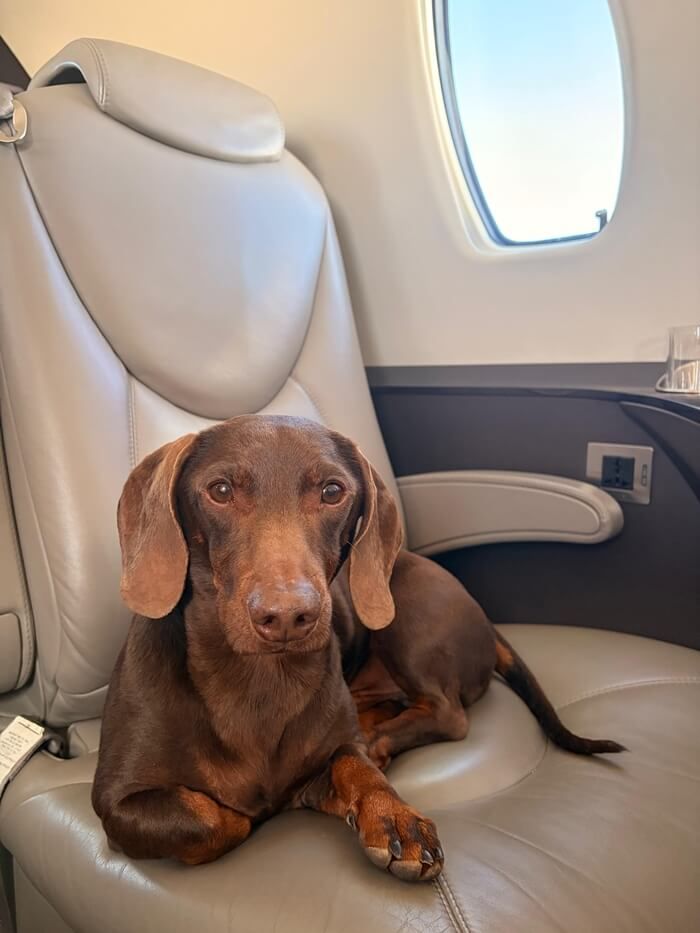
On most private flights, yes. Business jets have a pressurized, temperature-controlled cabin, and many operators allow small and medium-sized pets to travel with their owners, often in a carrier on the floor or on a seat. Because the cabin is shared only with your own party, there is no need for the separate cargo arrangements used on many commercial flights.
That said, cabin carriage is a policy, not a right. Some operators do not accept animals at all, some limit them to particular aircraft, and some require carriers to stay closed during taxi, takeoff and landing. Always confirm before you commit to a booking.
What do operator and aircraft policies usually cover?
Policies differ, but most operators look at the same handful of points.
Operator rules
Some operators welcome pets, others restrict them and a few do not allow them. Ask for the pet policy in writing, including any conditions on carriers, the number of animals and the use of seats or upholstery.
Aircraft and cabin
Cabin size, seating layout and ventilation matter. A larger cabin gives a bigger dog more room, while a very light jet may suit only a small pet in a carrier. Some aircraft are kept pet-free, for instance because later passengers may have allergies.
Size, breed and number of animals
Operators may set weight limits or ask about breed and temperament. Some countries and airlines apply special rules to certain breeds, so mention your pet’s breed early. Traveling with several animals may need prior approval.
What entry rules apply at the destination?
Entry rules are set by the country you are flying to, and sometimes by a country you transit through. In general terms, authorities look at these areas:
Microchip: an ISO-compatible microchip is commonly required so the animal can be identified.
Vaccinations: rabies vaccination is the most common requirement, often with a minimum waiting period after the shot.
Health certificate: a certificate from a veterinarian, sometimes endorsed by an official authority, issued within a set number of days before travel.
Travel documents: a pet passport where one is accepted, or other official paperwork, and in some cases specific parasite treatments.
Testing or quarantine: a few destinations still require blood tests, waiting periods or quarantine.
Timelines matter. Some steps take weeks or even months, so start well before your trip, ideally as soon as you know the destination.
How do US, EU, UK and other rules differ?
Only in general terms, because rules depend on the animal, its origin and the route, and they change. Always check the official government sources before you travel.
United States
Requirements for pets entering the US are set at the federal level and can differ for dogs and cats and depending on the country the animal is coming from. Individual states may add their own rules, and the requirements for pets leaving the US are set by the destination country. Check the current guidance from the relevant US agencies and ask your veterinarian to help you interpret it.
European Union and United Kingdom
EU countries broadly follow a common framework built around microchipping, rabies vaccination and an official document, although individual countries may add conditions such as extra treatments. The UK applies its own rules, which have changed in recent years and may change again, so they must be checked with official UK sources before every trip.
Other destinations
Some destinations, such as rabies-free islands, can be considerably stricter and may require long lead times, import permits or quarantine. Do not assume that the rules for one country apply to the next one on your route.
How are pets handled at airports and customs?
Private flights usually use general aviation terminals or dedicated handling facilities, which tend to be quieter than main terminals. On international flights, the handling agent normally arranges border and customs formalities, but checks involving animals can be additional. Officials may ask to see the microchip, vaccination record and health certificate on arrival, and sometimes at departure too.
Tell your handling agent in advance that an animal is on board so the right officials and any required inspection can be lined up. Keep every document in one folder, in paper form as well as digitally.
How can you keep your pet comfortable and safe?
A calm pet makes for a calmer flight. A few practical points help:
Use a well-ventilated carrier that is large enough for your pet to stand, turn around and lie down, and get your pet used to it weeks beforehand.
Pack a familiar blanket, water, a small amount of food, waste bags and absorbent pads.
Avoid a heavy meal shortly before the flight and offer a walk before boarding.
Keep a collar with ID tags and a leash or harness within reach.
Ask the crew how the carrier will be secured during takeoff and landing and about cabin temperature.
Discuss your pet’s age, health and any breed-related breathing issues with your veterinarian.
Should you sedate your pet before flying?
Do not give sedatives or tranquilizers unless your veterinarian advises it. Sedation can affect breathing and balance, particularly at altitude and in short-nosed breeds, and many vets advise against it for routine travel. Talk to your vet well before departure about alternatives such as carrier training and calming routines.
What does it cost to fly with a pet on a private jet?
Operators handle this differently. Some include pets at no extra charge, while others apply a pet fee, a cleaning fee or a deposit. Further costs can arise from vet visits, health certificates, official endorsements, microchipping, vaccinations and any treatment or quarantine at the destination. There may also be handling or customs charges at the airport.
Ask for a written breakdown so nothing comes as a surprise, and check whether extra cleaning is charged if the cabin needs special treatment after the flight.
What about service and assistance animals?
Trained service animals are usually treated differently from pets, and many operators will accommodate them. Even so, documentation, proof of training and destination entry rules can still apply, and they vary by country. Inform the operator as early as possible and ask what proof is needed.
When should you tell the operator about your pet?
As early as possible, ideally when you request a quote. Give the species, breed, weight, age, carrier size and number of animals. This lets the operator confirm whether the aircraft and crew can accept the animal, avoids last-minute cancellations and helps with cleaning and cabin preparation.
Pet travel checklist
Confirm the operator’s pet policy in writing.
Check the official entry and return rules for every country on the route.
Book a vet appointment early to check health, microchip and vaccinations.
Obtain the health certificate and any official endorsement within the required time frame.
Prepare a suitable carrier and get your pet used to it.
Arrange pet-friendly lodging and ground transportation at the destination.
Keep all documents together, in print and digital form.
Plan food, water, waste bags and a calm routine for the day of travel.
How can JetApp help you plan a flight with a pet?
JetApp compares available aircraft and operators for your route, date and group size. If you mention a pet in your request, you can ask operators about their pet policies, cabin options and any fees before you decide. The final conditions are always set by the operator and the countries involved, so keep your vet and the official sources in the loop.
Conclusion: can your pet fly private?
In most cases, yes, and often more comfortably than on a commercial flight. Cabin travel, flexible timing and quieter airports can make the journey calmer for everyone.
The key is preparation: confirm the operator’s policy, check destination rules early, involve your vet and keep every document at hand. With that in place, a flight with your pet can run smoothly.